Marriage & Parenting
How a Lagos Marriage Counsellor Helped Me Stop Feeling Like a Single Parent in My Own Home — In 30 Days
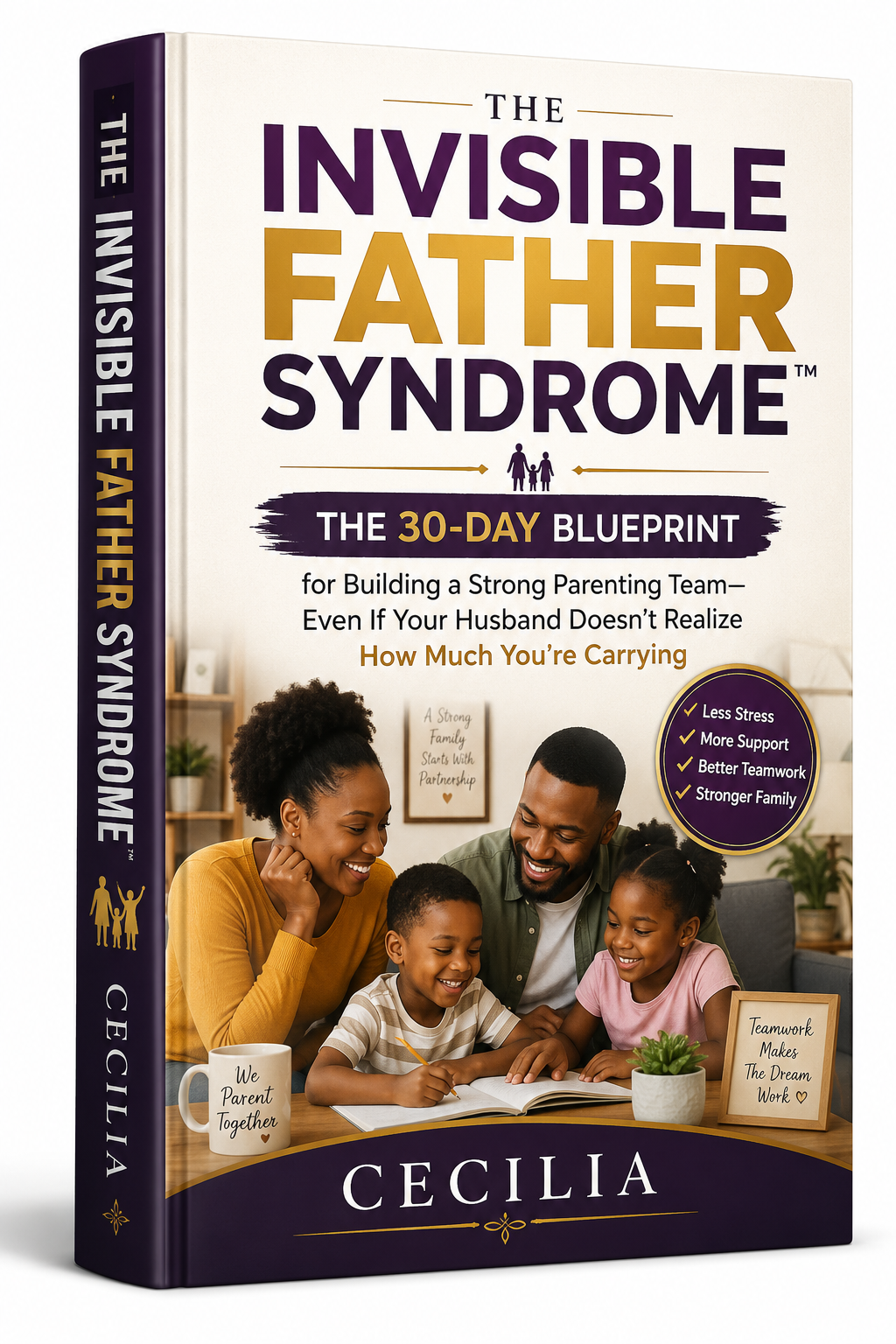
If you are doing everything in your home — the school runs, the homework, the cooking, the doctor appointments, the discipline, the emotional support — while your husband sits in the same house and somehow remains completely absent...
Read every word on this page.
If you have counted the number of times you asked him to help this week and then counted how many times he actually did — and the gap between those two numbers keeps you up at night...
Read every word on this page.
If you have started to feel a familiar loneliness. Not the loneliness of a single woman. Something worse. The loneliness of a woman who has a husband in the house but still carries everything alone.
If you have looked at him watching TV while you bathed the children, packed school bags, settled an argument between the kids, reminded the housekeeper what to cook, and reminded yourself to buy Emeka's school fees receipt — all before 8pm...
And then gone to bed with a full heart that had no space left in it to want anything from him that night.
If you know what it feels like to be technically married but functionally alone in your own home...
This page was written for you.
Not for the women whose marriages are finished. Yours is not finished. It is just unbalanced. And there is a very specific reason it keeps staying that way — a reason nobody has sat down to explain to you properly.
Until today.
"I know exactly what you are carrying. Because I carried it too — for four years before I understood what was actually happening."
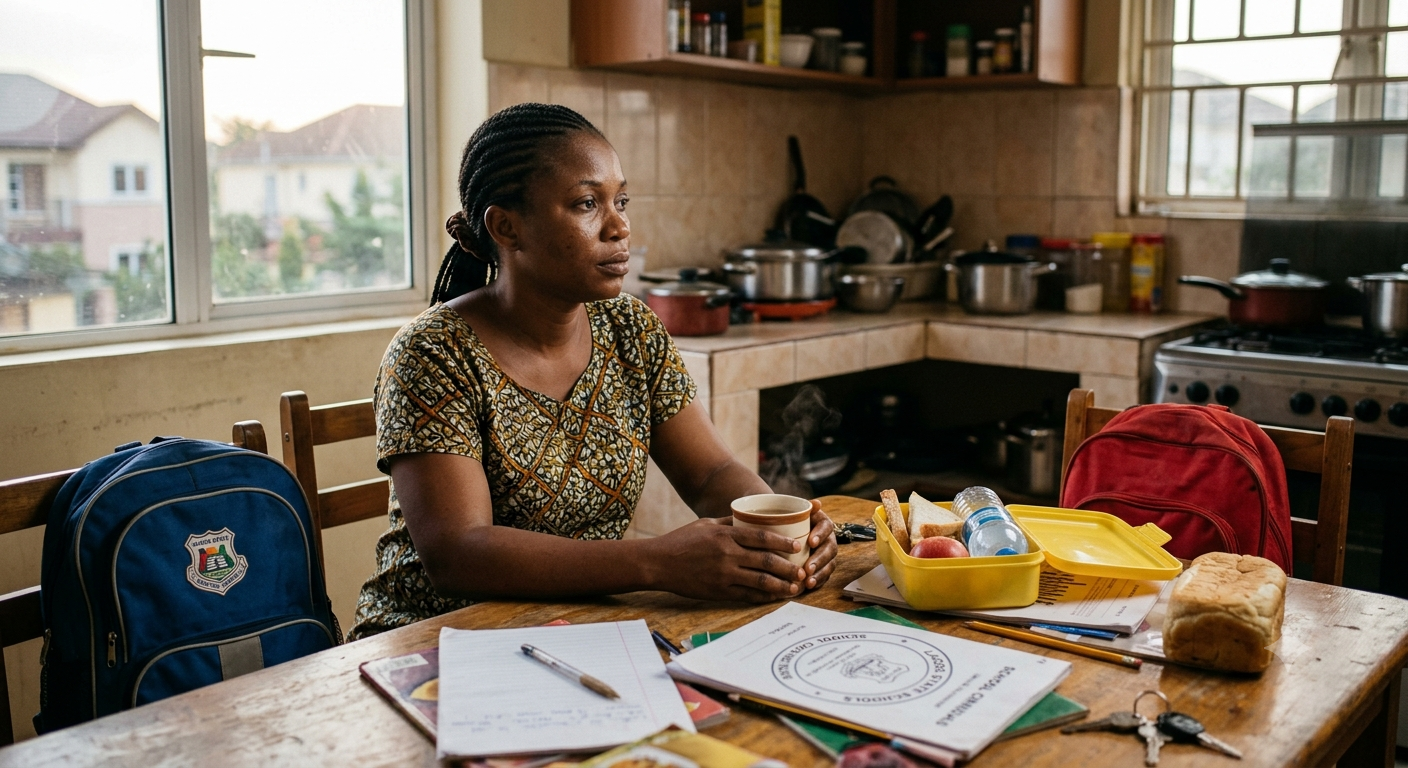
My name is Ada.
I am not a therapist. I am not a marriage counsellor. I am not a relationship coach with a certificate on her wall.
I am just a woman from Enugu who spent four years carrying a marriage on her back and telling herself it was love.
My husband, Chukwuemeka, is a good man. I want to say that clearly. He is not violent. He is not unfaithful — as far as I know. He goes to work. He brings home money. He calls himself a husband and a father and I believe he believes it.
But for four years of our marriage, I was the one who remembered every vaccination date. I was the one who knew which child liked their yam with egg and which one would throw a tantrum if the two were touching. I was the one who managed the school communications, the extended family drama, the church commitments, the house repairs, the generator fuel, and the emotional temperature of every single person under our roof.
Emeka's job was to go to work and come home. Mine was everything else.
When I complained, he would say, "But I provide for this family." As if providing money absolved him of every other thing. As if the children did not also need his presence. As if I did not also have a job — because I do. I work. I leave the house every morning too.
I spent close to ₦200,000 across four years — on marriage books, counselling sessions with people who gave general advice that changed nothing, women's conferences where everybody clapped and prayed but nothing shifted at home, and WhatsApp groups full of women who were equally exhausted and equally stuck.
The real pain was not the exhaustion. I could handle exhaustion.
The real pain was what it was doing to us. To me and Emeka. I had stopped seeing him as a partner. I had started seeing him as another person to manage. Another task. And he could feel it. He became more withdrawn. I became more resentful. We were polite strangers sharing a bedroom.
The intimacy disappeared. Not just physically — I mean the kind of intimacy where you look at your husband and feel safe. That was gone.
I stopped telling him my real thoughts because what was the point? He would not understand. He would not help. And I would end up more frustrated than if I had said nothing at all.
That is when I knew something had to change — not just in the house, but in how I understood the problem itself.
It was my cousin Ngozi's baby's naming ceremony in Surulere — last year August. One of those big Lagos gatherings where four generations show up and the food doesn't finish until evening.
In our family, these events are not just parties. They are the places where the older women gather in corners and the real conversations happen. Where your grandmother's friends sit together and say the things that do not appear in books.
I was there, trying to look present while my mind was running three different to-do lists. Emeka was on his phone in the corner. The children were running around. I had organised their clothes, packed their bags, reminded him three times what time we were leaving, and still arrived thirty minutes late because he "forgot" about the traffic on Third Mainland Bridge.
One of the older women noticed me. Her name is Mrs. Beatrice Okonkwo. She is seventy-one years old. Retired marriage and family counsellor. Forty-three years married. The kind of woman who has sat across from a thousand couples in her career and seen every version of this story.
She was watching me from across the room. Watching me manage the children, refresh Emeka's plate, greet relatives, answer my phone for a work issue, and smile through all of it.
Then she looked at Emeka, sitting comfortably in his chair, and something crossed her face.
It was recognition. And it was concern.
She crossed the room. She touched my hand.
"Come and sit with me for a minute," she said.
And I excused myself and sat.
She watched me for a long moment. Then she said, quietly:
"My daughter. You are carrying a marriage that has two people in it. All by yourself."
I did not cry in front of her. But I wanted to. Because in eleven words, she had named the thing I had not been able to name in four years.
The Discovery That Changed Everything
She asked me to come and see her the following Saturday. She lives in Gbagada. I went alone.
We sat in her sitting room — the kind of sitting room that feels like it has absorbed forty years of difficult conversations. Heavy curtains. Family photographs everywhere. A ceiling fan that moved slowly. She made tea and she did not rush.
She said the five words I had been waiting four years to hear:
"You are not failing your marriage. Your marriage has a structural problem that nobody taught either of you to see."
I cried. Not politely. Not the kind of tears you wipe quickly and compose yourself. I cried the way you cry when something you have been holding for a very long time is finally allowed to be put down.
She did not rush me. She waited. She handed me a handkerchief — a real cloth one, not tissue — and she waited until I was ready.
Then she started to talk.
She paused. She looked at me.
She picked up her cup of tea.
Here is what Mrs. Okonkwo helped me understand that afternoon — the thing that changed everything:
Your household has a natural operating system. It requires two people to run it properly — not because marriage books say so, but because the actual volume of work demands it. When one person starts carrying more than their share, the other person does not automatically notice and step in. They adapt to the new normal. The imbalance becomes invisible to them — not because they are cruel, but because the system is quietly working. From where they are standing, everything looks fine.
So it keeps going. And the carrying person gets more exhausted. And more resentful. And the gap between what they need and what they are receiving gets wider. And wider. Until the marriage itself starts to erode — quietly, politely, from the inside.
That is the Invisible Father Syndrome. It is not about a man who is absent from the home. It is about a man who is present in the home but invisible in the labour that keeps it running. And the fix is not an argument. It is a system. A structured, practical approach to making the invisible visible — and rebuilding the partnership deliberately.
"He is not recreating the imbalance on purpose. He is simply living inside it without seeing it. Your job is not to keep suffering silently — it is to illuminate it in a way he can finally receive."
I sat in that chair for three hours.
Three hours during which forty-three years of professional and personal experience was poured, carefully and specifically, into the specific problem of my specific marriage.
I thought about the ₦200,000 I had spent. The books. The conferences. The WhatsApp groups. And I thought: it took one woman, in a quiet room in Gbagada, to finally tell me what was actually happening.
Not "communicate better." Not "be more patient." Not "pray harder."
A structural diagnosis. And a practical path.
She walked me through a method. It is entirely natural. It requires no special training, no confrontation, no ultimatum. It takes less than five minutes a day in structured attention. You do it from your own home, in your normal routine. There is nothing painful about it. There is no shouting involved, no steaming, no grinding, no dramatic intervention.
It works by building a bridge — step by step, over thirty days — between your husband's good intentions and the daily reality of your home. It creates visibility where there was invisibility. It replaces resentment with structure. And it does something remarkable: it makes him want to participate, rather than feeling attacked into it.
The First Week: Nothing. Absolutely Nothing.
I will not lie to you.
Day one. Day two. Day three. I followed the method. I kept the structure. Nothing changed in the house.
Emeka came home from work, watched TV, ate, slept. I managed everything the way I always had. On Day four, I almost stopped. I thought: this is another thing that sounds good in someone's sitting room and does nothing in real life.
But I remembered what Mrs. Okonkwo had said. "Do not try to rush the thirty days." She had specifically warned me that the first week would feel like nothing. She called it "the silent phase." The work is happening, she said, even when you cannot see it yet.
So I stayed with it.
Day 7: The First Sign
It was a Thursday evening.
I was in the kitchen. Emeka walked in — not to eat, not to get something — just to stand there for a moment. He looked around. He was quiet for a few seconds. Then he said:
"Babe. You do a lot in this place. I don't think I've been... I don't know. I don't think I've been seeing it properly."
He did not do anything dramatic. He did not make a speech. He just said that and walked back to the sitting room.
I stood at the cooker and I did not move for a full minute.
Something had shifted. Not in the house. In him.
Day 10. Day 14. Then Something Broke Open.
By Day ten, he started asking. "What can I help with tonight?" Not perfectly. Not consistently. But the question started appearing.
By Day fourteen, he had taken over the school run on Wednesdays entirely. His idea. He told me he had cleared his morning on Wednesdays specifically for it.
Day seventeen: he handled a parent-teacher WhatsApp group situation that I had always managed alone. He did not ask me to explain it. He just handled it.
Day twenty-two: I woke up to find he had already packed the children's bags. Both of them. Correctly.
And on Day twenty-eight, I realised something that still gets me when I think about it now.
I had not checked the school bag the night before. I had forgotten. For the first time in four years of packing school bags every night, I had forgotten to check — because some part of me had begun to trust that it would be handled.
"I forgot to check. After four years of never forgetting. That was the moment I knew it had really changed."
But the real test was yet to come.
Friday Night
It was the last Friday of the month.
The children were asleep. The house was quiet in the way it only gets after 9pm. Emeka came to where I was sitting and he sat beside me — not on the other end of the sofa, but beside me, close — and he just put his arm around me.
I did not move away.
I want to explain why that matters. For years, when he reached for me in the evenings, I would stiffen. Not because I did not love him. But because by the time evening came, I was so emptied by everything the day had required of me that I had nothing left. No softness. No openness. Only the quiet, chronic exhaustion of a woman who had been doing everything alone.
That Friday, I leaned into him instead.
Later, when everything was quiet and he was holding me in the dark, he said something I was not prepared for. He said, "I feel like I've come back to you. Like I've been somewhere else and I've come back."
I cried. Not from sadness. From relief. The kind of relief that feels physical — like something that has been tight in your chest for a very long time is finally, finally releasing.
"He held me like he was apologising for every night he hadn't noticed. And I let him."
I Did Not Plan to Tell Anyone
I went back to Mrs. Okonkwo after Day thirty. I sat in the same chair. I told her everything.
She laughed. Warmly. The way someone laughs when they have seen the same story resolve itself too many times to be surprised.
I told my friend Chisom almost by accident. She had called me one afternoon and something in my voice must have been different — lighter. She asked what happened. I told her.
She was quiet for a long time. Then she said: "Ada. That is exactly what is happening in my own house. Exactly."
Chisom tried it. Then she sent it to her colleague in Abuja. That colleague sent it to her sister in Port Harcourt. Within three months, I was receiving voice notes from women I had never met, from Kano to Calabar, telling me that something had finally shifted.
Woman to woman. No advertising. Just the truth passing from one exhausted wife to the next.
Blessing A., 34 — Ikeja, Lagos
"I cried reading Ada's story because it was my story. Tunde was not a bad man — he just truly, genuinely did not see what I was carrying. By week two of following this method, he sat down and asked me to show him what needed to happen in the house. He used the word 'us.' I almost fell off my chair. We had not used that word about household things in three years."
Fatima Y., 38 — Abuja, FCT
"My husband Ibrahim is a serious man. Very traditional. I was afraid the approach would make him feel attacked. It did not. It was structured in such a way that he came to the realisation himself — I did not have to fight for it. He started picking the children from school on Tuesdays. He started asking about homework. The shift was quiet but it was real."
Ngozi E., 31 — Enugu
"I had concluded my husband was just lazy. I was wrong. He was disconnected — there's a difference. This guide explains that difference and shows you exactly how to reconnect him to the daily life of your family without dragging him or nagging him. Day 21 was my breakthrough day. I remember it exactly. E no easy — but e work."
Amara O., 42 — Port Harcourt, Rivers State
"At my age and stage, I had accepted that this is just how it is. That was my mistake. It is NOT just how it is. It is a structural problem with a practical solution. My husband Kingsley now chairs our Sunday family meeting — his idea. Who is this man? I'm laughing but I'm also serious. This thing works."
Hauwa M., 29 — Kano
"I bought this guide six weeks after having my second baby because I was drowning and my husband didn't know I was drowning. That's the part that hurt most — he didn't know. The Responsibility Mirror exercise in the bonus workbook was what cracked it open for us. He saw the numbers. He could not argue with the numbers. We are building something together now. Finally."
Ronke B., 36 — Ibadan, Oyo State
"I want to be honest: I was looking at exit options. Not because of anything dramatic — just because I was so lonely inside my marriage and I couldn't see a way through. I am not exaggerating when I say this guide changed the trajectory of my family. My husband and I are genuinely partners now. It took thirty days and it took patience but my God — it was worth it."
Same method. Same structure. Same thirty days. Same results.
Why I Am Sharing This
I went back to Mrs. Okonkwo and I told her what had been happening. The women who had reached out. The voice notes. The results coming in from Abuja and Port Harcourt and Kano.
She listened to all of it.
Then she was quiet for a moment.
I asked her: "Mama — can I write this down properly? Can I document everything you taught me so that more women can access it?"
She thought about it. Then she laughed again — that same warm laugh.
"Do it," she said. "But make sure they understand one thing."
Now Available
The Invisible Father Syndrome™
The 30-Day Blueprint for Building a Strong Parenting Team — Even If Your Husband Doesn't Realise How Much You're Carrying
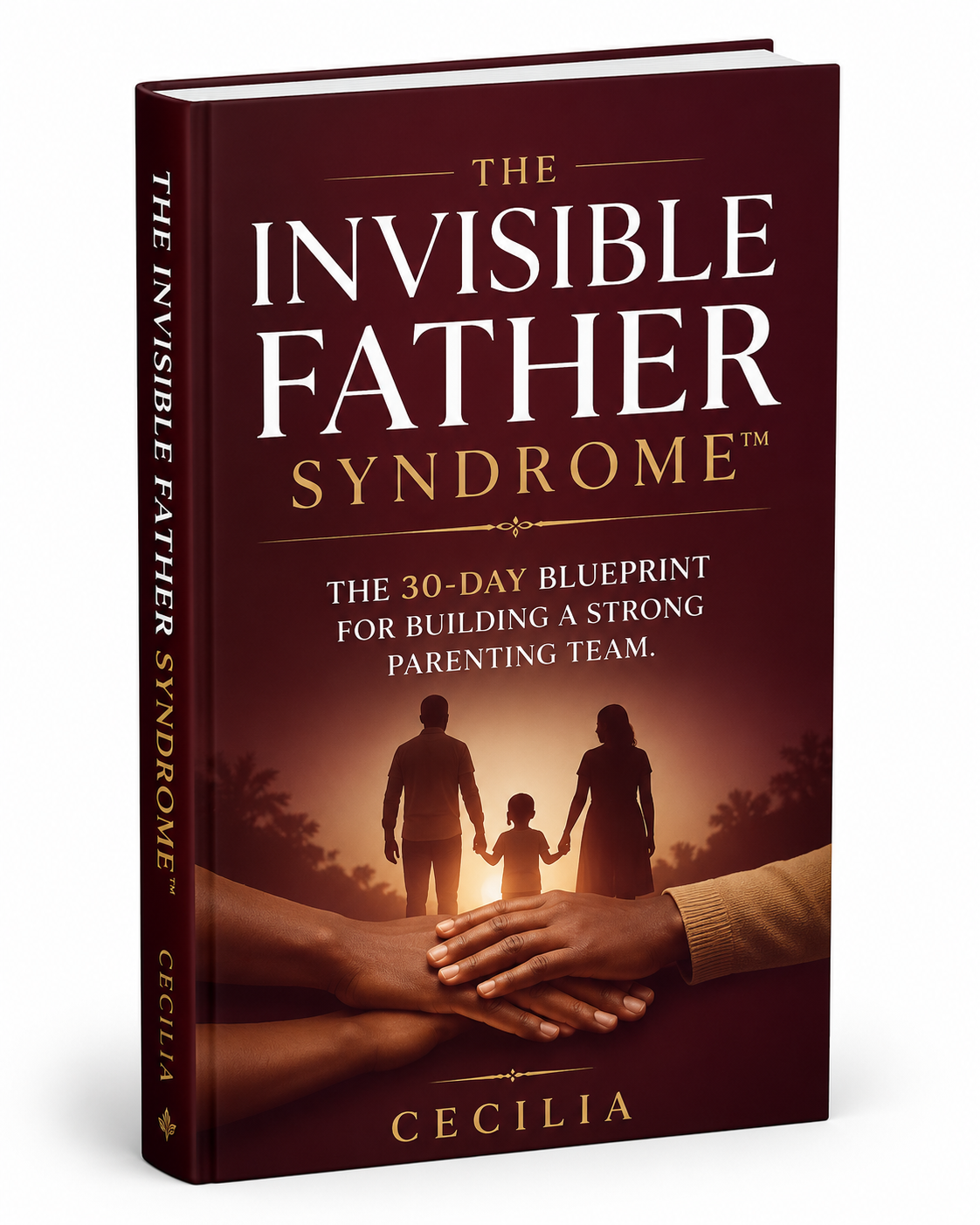
Everything Mrs. Okonkwo taught me — documented, verified, written in plain language so you can begin tonight — is inside this guide.
Not theory. Not general advice that could apply to anyone. Specific, structured, sequenced steps built around the exact dynamic of a home where one partner is carrying everything while the other does not yet realise it.
This is the guide I wish had existed four years ago.
- Why You Feel Like a Single Parent Even Though You're Married (Ch. 1) — The real reason you wake up already exhausted, the invisible work nobody names, and the moment one Nigerian mother realised she was carrying her entire family inside her head before breakfast every morning.
- The Invisible Father Syndrome™ Explained (Ch. 2) — Exactly what this pattern is, the four clear signs it is present in your home, and why so many good, loving husbands become invisible in the daily work of raising a family without either of you noticing it happening.
- The Default Parent Trap™ — How You Ended Up Carrying Everything (Ch. 3) — The concept of Responsibility Drift™, the five different buckets of work you carry simultaneously (including the two nobody ever talks about), and why simply asking for "help" will never solve this problem.
- The Responsibility Mirror™ — Making the Invisible Finally Visible (Ch. 4) — A step-by-step exercise that reveals, on paper, exactly who carries what inside your home. The tool that shows your husband the weight he cannot feel — without accusation, without argument, without tears.
- The Reset Conversation™ — Getting Him to Listen Without Starting a Fight (Ch. 5) — The Three-Conversation Method™ that moves your husband from defensive to thoughtful. Exact phrases to use, what to avoid saying, and how to invite partnership instead of igniting conflict.
- From Helper to Partner — Rebuilding Your Parenting Team (Ch. 6) — How to create Ownership Zones™, the Sunday Reset Meeting™ that takes 20 minutes per week and prevents months of resentment, and the Five-Minute Daily Check-In™ that keeps your family aligned every evening.
- The 30-Day Invisible Father Reset Plan™ (Ch. 7) — A complete day-by-day roadmap across four weeks: Awareness, Conversation, Ownership, and Partnership. Exactly what to do on Day 1, Day 8, Day 15, and beyond — so you never wonder "what do I do next?"
- How to Make Sure You Never Go Back (Ch. 8) — How to protect the new habits during difficult seasons, what real success looks like in a family, and the Family Partnership Promise your husband and you sign together to make the change permanent.
You do not need to attend any seminar. You do not need your husband to agree to anything before you start. You do not need to spend money on a counsellor. Everything inside this guide can be started tonight from your own home, using your normal life as the practice ground. Total investment in materials? Zero. Everything is inside the guide itself.
Compare That to What You Have Already Been Spending
- General couples counselling sessions — ₦15,000–₦40,000 per session: Two people in a room with someone who has never lived inside your specific home, your specific culture, your specific dynamic. Most sessions produce insights. Very few produce the structural change that actually reorganises how your household operates day to day.
- Marriage enrichment conferences — ₦10,000–₦30,000 per ticket: You leave feeling inspired. You return to the same house, the same imbalance, the same Tuesday night where you are doing everything while he watches football. The inspiration fades within two weeks.
- Marriage books from the bookshop — ₦4,000–₦12,000 per book: Full of principles. Short on the practical specifics of your situation. Most were written for Western couples, not Nigerian homes where culture, gender expectations, and family pressure add extra layers that generic advice cannot address.
- WhatsApp group memberships and online communities — your time and energy: Useful for feeling less alone. Not useful for actually changing the structure of your home. A group of exhausted women cannot give each other what none of them yet have.
- Doing nothing and hoping it changes on its own — ₦0 cash, everything else: The strategy most women default to. The years compound. The resentment deepens. The intimacy erodes further. And one day you look up and realise your children have grown up watching a marriage where one person carries everything and calls it love.
- The real cost — the one nobody puts a number on: Four years of building up resentment instead of partnership. Four years of a husband who remained unaware because nobody showed him. Four years of a marriage quietly erosing while both of you were physically present in the same house. That cost does not show up in any receipt.
How Much Does This Guide Cost?
Let me be transparent with you about what it took to put this together properly.
- Professional writing and structuring of Mrs. Okonkwo's complete framework — ₦45,000
- Review and verification sessions with Mrs. Okonkwo herself across multiple meetings — ₦28,000
- Testing the 30-Day Blueprint with a group of twelve women across Lagos, Abuja, and Port Harcourt before publishing — ₦22,000
- Professional design and layout of the guide and all bonus materials — ₦18,000
- Technical setup for secure digital delivery — ₦9,000
- Total invested: ₦122,000+
A fair price for this guide, given what it contains and what it cost to create, would be ₦25,000.
But I know the season we are in. I know what the economy is doing to Nigerian families right now. I know that the women who need this most are often also the ones managing household finances on a tight margin.
So if you are reading this today —
Your Investment Today
₦25,000
₦8,500
This price is only guaranteed for the first 50 women who complete payment today.
GET INSTANT ACCESS NOW — ₦8,500Once You Click That Button, Here Is What Happens
- You are taken to a secure payment page where you can pay by card, bank transfer, or USSD — whichever is easiest for you.
- You complete your payment. The system confirms it automatically.
- Within 60 to 90 seconds, your complete guide plus all three bonuses are delivered directly to your WhatsApp number AND your email address. You can begin reading immediately.
It is me, Ada. As long as your payment is confirmed, your access is 100% guaranteed. No waiting. No chasing. Straight to your phone.
What Happens in the First 7–14 Days
Real conversations. Real women. Real results.
WAIT — I Have Something Special For You…
If you are among the first 50 women to complete payment today, you receive all three of these bonuses completely free — delivered alongside your guide in the same package.
Bonus #1
The Invisible Father Scorecard™
Perceived Value: ₦7,000 — FREE today
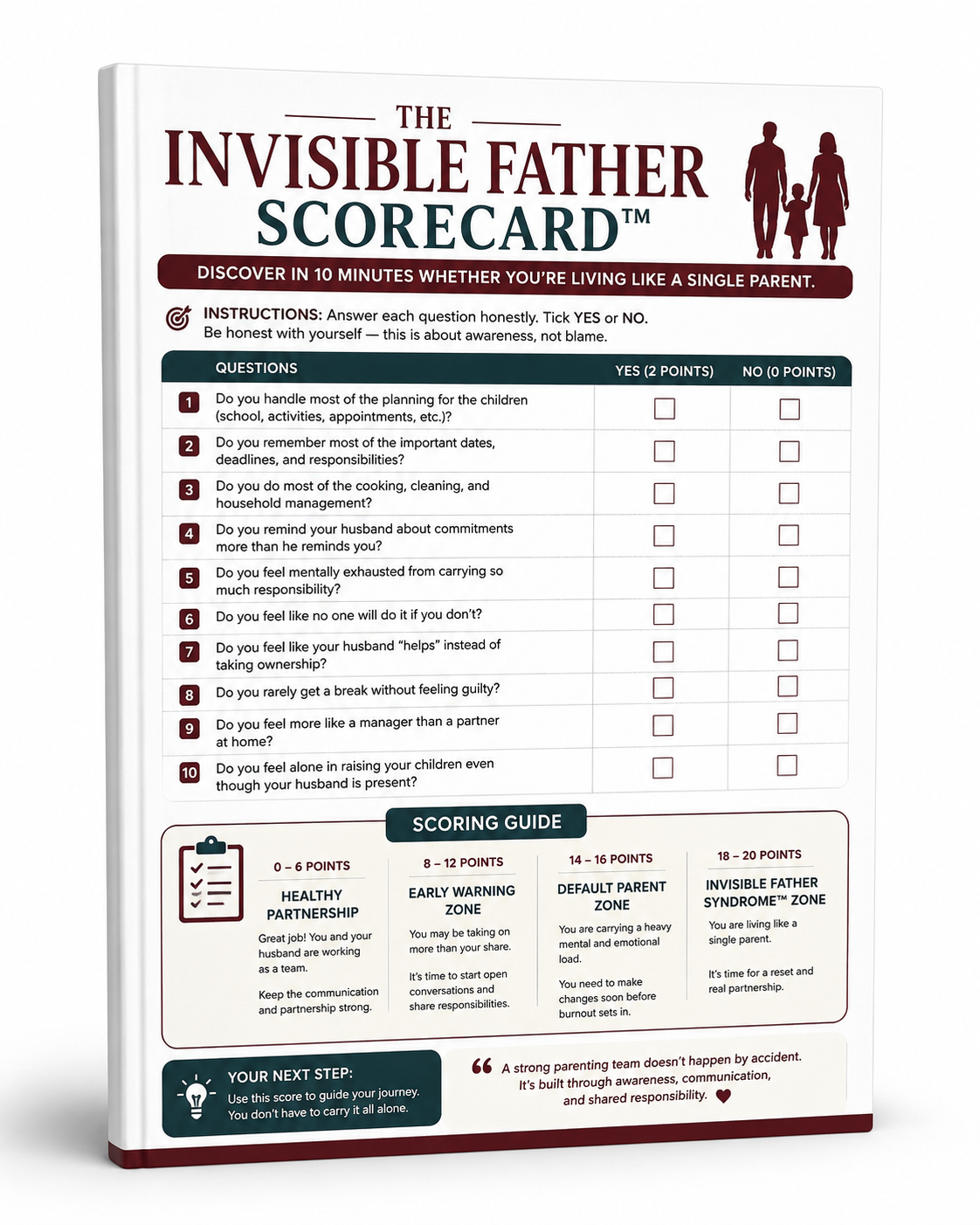
A 20-question self-assessment that tells you in ten minutes exactly which zone your marriage is in — Healthy Partnership, Early Warning, Default Parent Zone, or Full Invisible Father Syndrome™ Zone. Many women know they are overwhelmed but cannot explain why. This scorecard gives you clarity, validates what you are experiencing, and tells you exactly where to start inside the guide.
Bonus #2
The Responsibility Mirror™ Printable Workbook
Perceived Value: ₦10,000 — FREE today
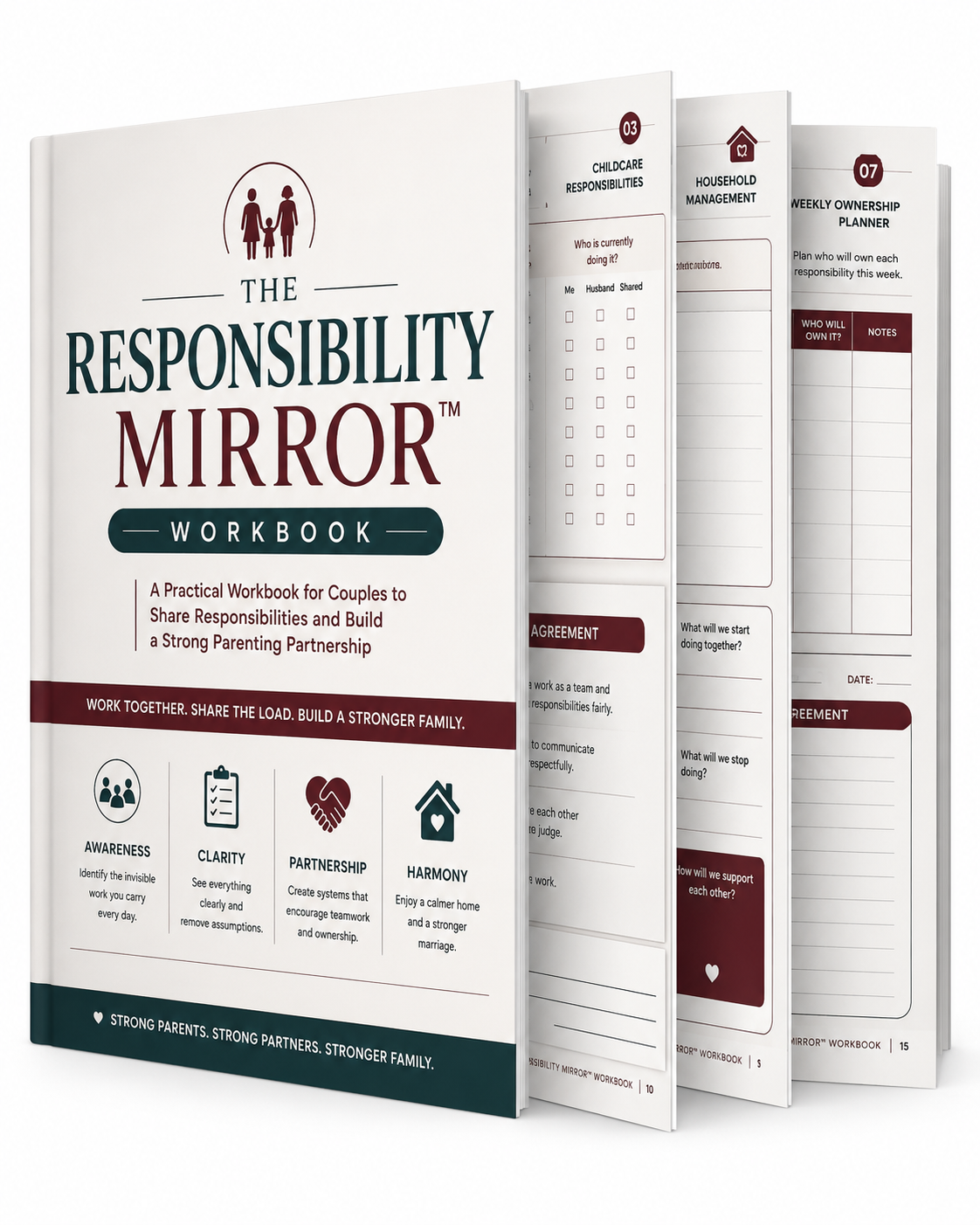
This is the workbook that turns the ideas in the guide into action. It walks you — and eventually your husband — through the Responsibility Mirror™ exercise that makes the invisible weight visible. Includes the Family Responsibility Audit, Mental Load Checklist, Childcare Tracker, Household Management Worksheet, Weekly Ownership Planner, and the Family Partnership Agreement. Print it. Fill it in. Use it together.
Bonus #3
The Difficult Conversation Script™
Perceived Value: ₦12,000 — FREE today
Many wives know they need to have the conversation. They do not know how to start it without it becoming an argument within three minutes. This bonus gives you the exact words. How to begin. What to say if he becomes defensive. How to explain the mental load. How to ask for shared ownership instead of "help." What to avoid. A 15-minute conversation template. The fear of the conversation is the last thing standing between you and real change — this removes that fear entirely.
Everything You Are Getting Today
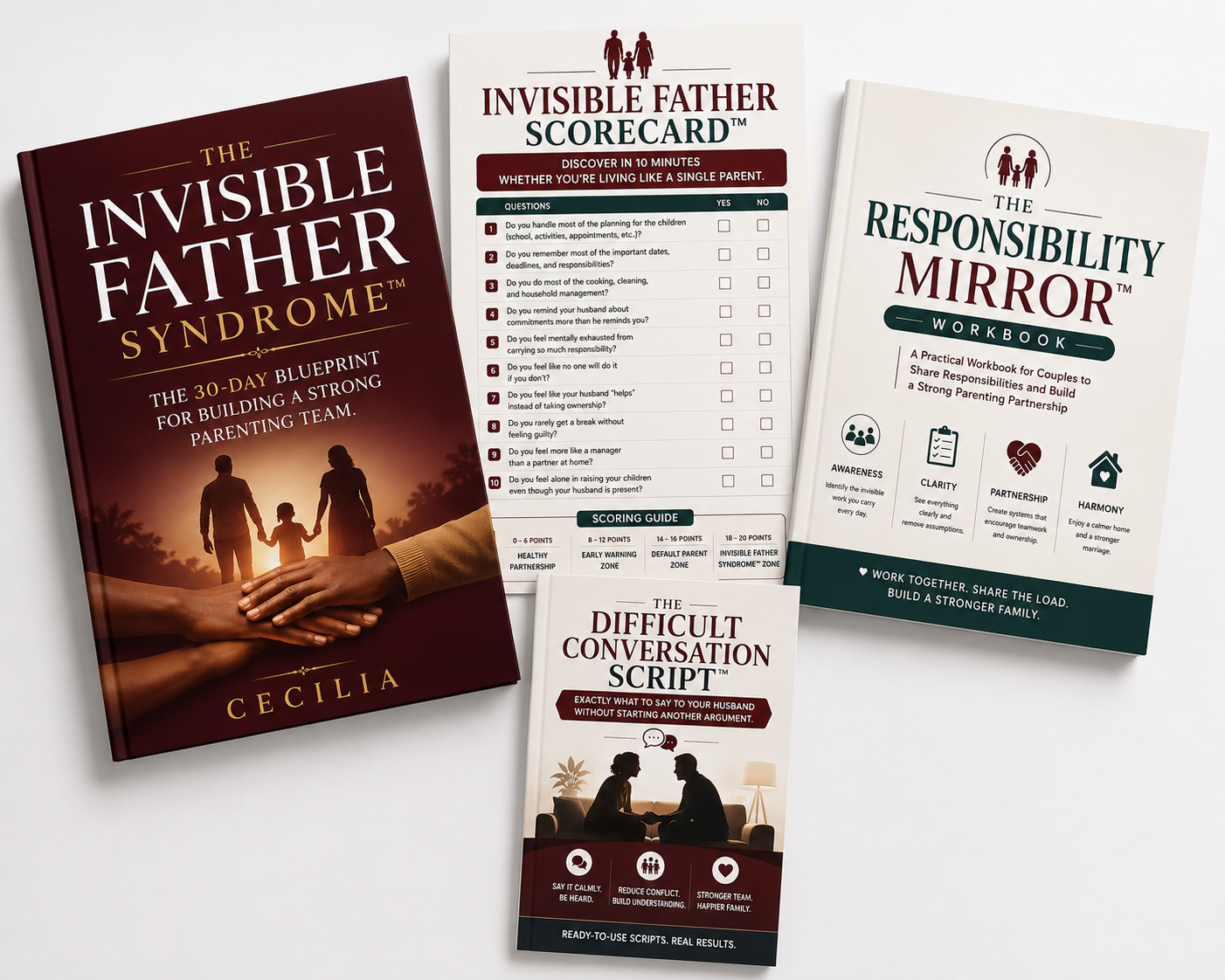
- The Invisible Father Syndrome™ — The 30-Day Blueprint ₦25,000
- BONUS #1: The Invisible Father Scorecard™ ₦7,000
- BONUS #2: The Responsibility Mirror™ Printable Workbook ₦10,000
- BONUS #3: The Difficult Conversation Script™ ₦12,000
Right Now, You Have Two Choices
Choice 1: Do Nothing
- Go back to the same Tuesday nights where you are doing everything while he watches TV.
- Continue carrying a weight that grows heavier the longer it is ignored.
- Watch the distance between you and your husband increase in small, daily increments.
- Raise children who are learning that one parent does everything and calls it normal.
- Wonder, ten years from now, what might have changed if you had tried something different today.
Choice 2: Start Tonight
- Begin the 30-Day Blueprint with clarity about exactly where your marriage stands and what to do first.
- Build visibility where there has been invisibility — without confrontation, without arguments.
- Watch a good man become the partner he always intended to be, once someone showed him how.
- Reclaim the intimacy, the softness, the sense of safety that the imbalance has been slowly taking.
- Raise children who grow up watching two people build a life together — as a team.
The Invisible Father Syndrome™ + All 3 Bonuses
₦54,000 Total Value
₦8,500
One-time payment. Instant delivery to WhatsApp and email. First 50 women only at this price.
GET INSTANT ACCESS NOW🛡 30-Day Money-Back Guarantee
Follow the 30-Day Blueprint exactly as written. Complete the daily actions. Use the Responsibility Mirror™ method. If you have genuinely followed the protocol for thirty days and seen no measurable shift in your husband's engagement with your home and children — I will refund every naira. No argument. No interrogation. Full refund. That is my promise to you, and it is specific because the method is specific.
One Last Thing…
Picture yourself one month from today.
Will you know which zone your marriage was in — and have done something about it?
Will your husband have said, at least once, unprompted, "What do you need from me tonight?"
Will the school bags have been packed by someone else, at least once, without you asking?
Will you have had the conversation you have been afraid to have — with the words to guide you through it — and survived it, and come out the other side with something better?
Will you have cried in the kitchen — not from exhaustion, not from frustration, but from the specific relief of realising you are not doing this alone anymore?
Now picture yourself one month from today if you close this page. Nothing changes. Everything stays exactly as it is. The Tuesday nights. The silent bedroom. The invisible weight that has no name but sits on your chest every evening.
The difference between those two versions of you is a decision you make in the next sixty seconds.
TAKE ME TO THE PAYMENT PAGEIf you have read this far and you are still hesitating —
I want to ask you something honestly.
What are you hesitating about?
The money? You have spent more than ₦8,500 on things that changed nothing. You know you have.
Whether it will work? You just read the results. From Kano. From Enugu. From Port Harcourt. From women whose husbands were exactly like yours.
Whether you deserve it? That is the real question, isn't it?
If you cannot invest ₦8,500 in the marriage you are inside of every single day — in the partnership that will shape what your children understand love to look like — how do you expect your husband to invest his presence and his energy in it?
Change begins with the person who sees the problem. You are the one reading this page. You are the one who sees it.
Stop hesitating. Choose yourself. Choose your marriage. Choose your family.
I'M READY — GET ME INSTANT ACCESSP.S. — This guide comes with a 30-day full money-back guarantee. Follow the method. All of it. For thirty days. If nothing shifts, you get every naira back. There is no risk here — only the risk of doing nothing.
P.P.S. — This page is offering the ₦8,500 price for the first 50 women only. After that, the price returns to ₦25,000. If you close this page and come back tomorrow, I cannot promise this offer will still be here.
P.P.P.S. — Every day you wait is another day your husband does not see what you are carrying. Another evening of managing everything alone. Another night of going to bed with a full heart that has nothing left. The method works. But only if you start it. Tonight.
With love for your marriage,
Ada
Frequently Asked Questions
How is the guide delivered after payment?
Immediately after your payment is confirmed — usually within 60 to 90 seconds — the complete guide and all three bonuses are sent directly to your WhatsApp number and your email address. You do not need to download anything separately or wait for anyone to send it manually. It is fully automated and instant.
My husband is very traditional and doesn't like being "managed." Will this work for him?
Yes — and in fact, this method was specifically designed with that personality type in mind. The framework does not ask you to manage him or confront him. It creates conditions in which he comes to his own realisation, at his own pace. The shift feels like his idea, not like something he was pushed into. Traditional men often respond more strongly to this method than men who are already open to conversation, because the realisation, when it comes, carries more weight for them.
What if my situation is severe? We have been unbalanced for many years.
The guide includes a dedicated section — The Relapse Prevention Protocol (Page 44) — specifically for women who have been carrying this imbalance for more than five years. There is also extended guidance within the 30-Day Blueprint for more entrenched situations. Long-standing imbalances typically take the full thirty days — sometimes slightly more — but the evidence from women who have followed it is consistent: the longer the imbalance, the more noticeable the shift when it starts to correct.
What if my husband remains skeptical or resistant?
Bonus #3 — The Difficult Conversation Script™ — addresses this specifically. It includes what to say if he becomes defensive, how to handle a shutdown, and how to reframe the conversation from "you are failing" to "we have an opportunity." Additionally, the Responsibility Mirror™ exercise in Bonus #2 uses data rather than emotion as its foundation. Data is very difficult to argue with. Most skeptical husbands move from defensive to reflective within the first two weeks of the method, not because they are told to, but because they can finally see what they couldn't see before.
Is the money-back guarantee real?
Yes. Completely real. Follow the 30-Day Blueprint as written — all of it, in sequence, for the full thirty days. If you do this and see no measurable shift in your husband's engagement with the home and children, contact me directly and I will process a full refund. The guarantee is specific because the method is specific. I am not offering a vague promise — I am standing behind a structured protocol.
Why is this different from every other marriage guide I have tried?
Most marriage guides give you principles. "Communicate better." "Be more patient." "Set boundaries." Those are not wrong — but they are not specific enough to change the daily structure of your home. This guide gives you a precise, day-by-day framework built around the exact dynamic of a home where the Invisible Father Syndrome is present. It was developed through forty-three years of professional practice by someone who has sat across from hundreds of Nigerian couples with this exact pattern. It is not general advice. It is a specific protocol for a specific problem — and that specificity is why it produces results where general advice has failed.
© 2025 Mums Corner Blog. All Rights Reserved.
This page is for educational and informational purposes. Results may vary. Individual outcomes depend on consistent application of the method as described.
Comments (247)
Leave a Comment